Flocked tree safety with kids and pets
A flocked artificial tree is a low-risk thing to have at home when it is placed and lit with care. Most of the risk comes from nearby heat, tired light strings and a stand that a toddler or a cat can pull over.
Where the tree goes
Placement is the first safety decision and the easiest to get right. The National Fire Protection Association (NFPA) advises keeping a Christmas tree at least 3 feet from any heat source, which includes fireplaces, radiators, space heaters and heat vents.
Candles count too, and a lit candle should never sit on or near a tree. The drawing below shows a sensible spot in a typical living room.
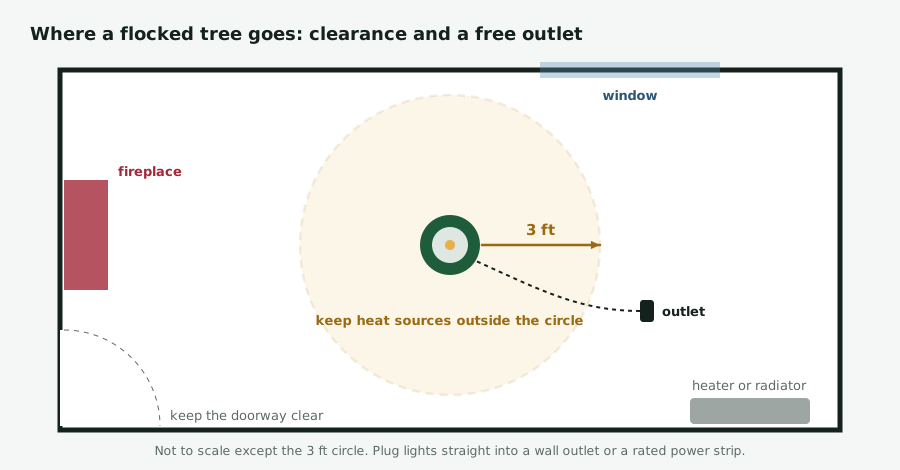
- Leave 3 ft of clear space between the tree and anything that gives off heat
- Choose a spot close to a wall outlet, so no cord crosses the room
- Keep it out of doorways and walkways, where people brush past
- Avoid a sunny window if you want the flocking to stay white
Floor space counts here as much as height. A full-size 7.5 ft tree often covers over 4 ft of floor, and our tree size guide shows how to measure the space before you buy.
What fire-resistant means
The Consumer Product Safety Commission (CPSC) says an artificial tree should be labeled fire resistant. The label means the material resists burning, not that it cannot burn, so the 3 ft rule applies just the same.
Five of our six trees mention it in some form. National Tree Company calls the Acacia Slim and Wintry Pine needles fire-resistant, Best Choice Products lists flame-retardant PVC branches, and the Yaheetech and Hykolity listings say flame resistant.
The 3 ft mini’s listing says nothing either way. Our glossary entry on fire-resistant trees explains the terms, and flocking that contains a flame retardant is a bonus, not a reason to relax.
Lights and cords
NFPA notes that a share of home Christmas tree fires involve electrical distribution or lighting equipment. That makes the lights and cords the part to watch, more than the tree itself.
- Use lights with a UL or ETL mark from a qualified testing laboratory
- Use indoor lights indoors and outdoor-rated lights outside
- Replace any string with a worn or broken cord or a loose bulb connection
- Follow the maker’s limit on how many strings connect end to end
- Don’t overload an outlet or chain power strips together
- Never run cords under rugs or through doorways, where they get pinched
- Turn the tree lights off when you go to bed or leave home
A plug-in timer makes the last rule automatic. LED strings run cool to the touch and use far less electricity, while incandescent minis get warm, as our LED or incandescent lights guide explains.
On a pre-lit tree, check the listing for the testing-lab mark. The National Tree Company Acacia Slim lists UL-listed clear lights, for example.
Some owners of pre-lit trees say whole sections stop working. Treat that as a reason to contact the seller or replace the string, never to cut and splice wires yourself.
Toddlers and a steady stand
Four of our six trees weigh more than 30 lb per their listings, and a child swinging on a low branch can still pull one over. The stand is the first thing to check.
- Open the stand fully and lock every leg before the first section goes on
- Anchor the tree to a wall hook, or weight the base, while toddlers are around
- Hang breakable and small ornaments high, out of reach
- Keep plugs, spare bulbs and hooks where little hands cannot reach them
- Consider a play yard panel or gate around the base
A small tree on a sturdy table is another answer for the youngest children. The National Tree 3 ft tabletop tree sits on a metal plate base and weighs 4 lb, so set it well back from the table edge and tuck its cord away.
Our guide to slim and tabletop flocked trees compares the options when floor space and safety both matter. A slim tree also leaves a smaller base to fence off.
Pets, children and flocking
Flocking is fine fibers held by an adhesive, sometimes with a flame retardant, and it is not food. Stop pets and toddlers from chewing branches, and call a vet or a doctor if a lot has been swallowed.
Cats like to climb, and dogs tend to bump trees with their tails or chase what dangles. The same anchored stand protects against both.
- Leave the lowest branches free of tempting ornaments
- Choose shatterproof ornaments for the lower half of the tree
- Skip edible decorations such as popcorn strings
- Vacuum shed flocking from the floor so pets don’t lick it up
Shedding is heaviest during setup, so that is a good time to keep pets in another room. Our guide to stopping a flocked tree from shedding has more ways to keep the floor clean.
A yearly checklist
Run through these points each year as the tree goes up. They take a few minutes and follow the advice from NFPA and the CPSC.
- Tree 3 ft from every heat source and clear of doorways
- Lights with a UL or ETL mark, cords undamaged
- Plugged into a wall outlet, with no overloaded strips
- Stand locked, and anchored if kids or pets live with you
- Lights off at bedtime and whenever you go out
If you are still choosing, our list of the safest flocked trees we recommend covers all six, and the tips before you buy add what to look for on a listing. Each home card, such as the Acacia Slim card, names the tree’s materials.
If you want tested lights and a small footprint
The National Tree Company Acacia Slim comes with 350 UL-listed clear lights and needles the maker calls fire-resistant, on a 26 in base that is easy to keep clear of heat. Its incandescent bulbs get warm, so it still needs the 3 ft gap and lights off at night.